
How SEO Generated 65 Paid Leads for POCUS.pk in Just 30 Days
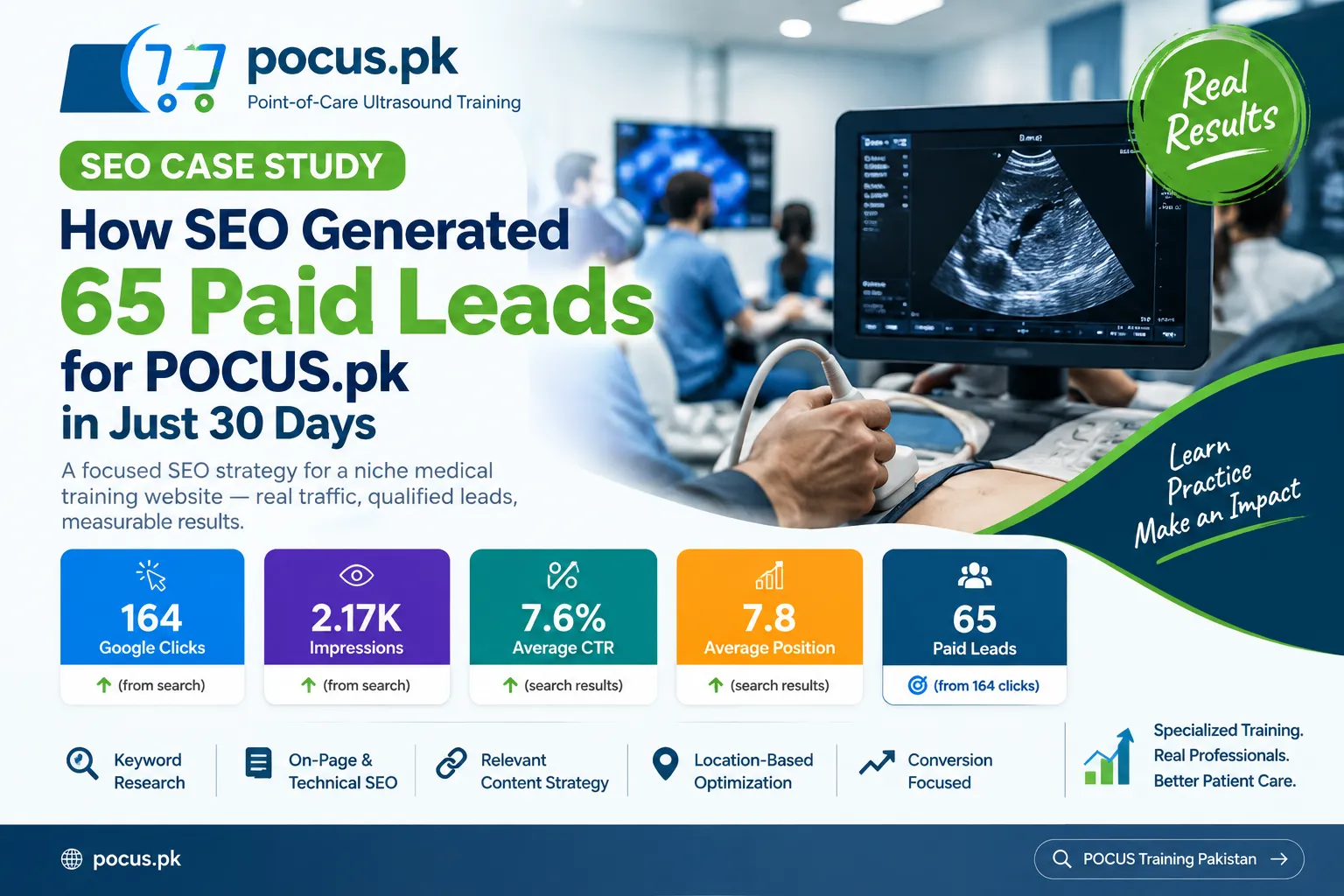
SEO Case Study: How POCUS.pk Generated 164 Google Clicks and 65 Paid Leads in 30 Days
Website: POCUS.pk
Industry: Medical Education & Professional Training
Niche: Point-of-Care Ultrasound (POCUS) Training
Reporting Period: 5 July – 5 August 2026
Data Source: Google Search Console
Business Result: 65 successful paid leads
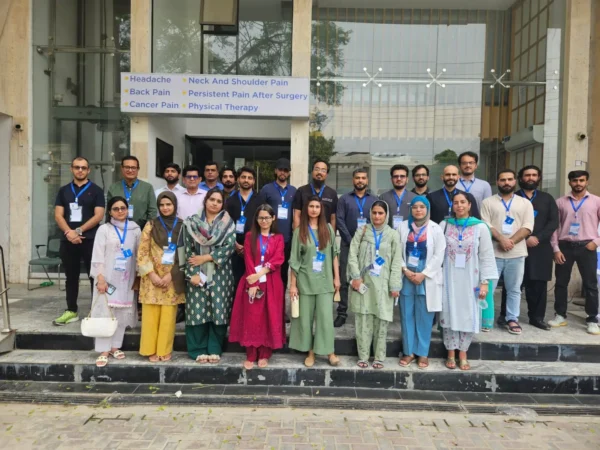
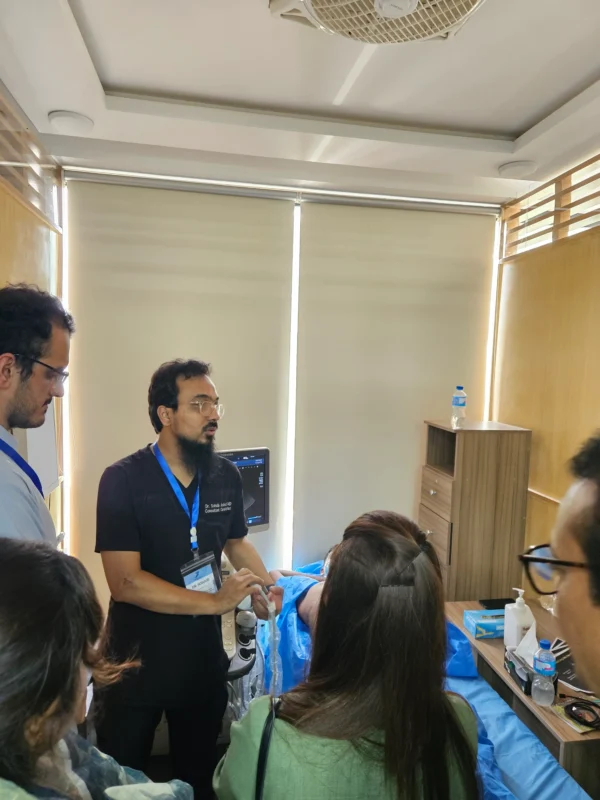
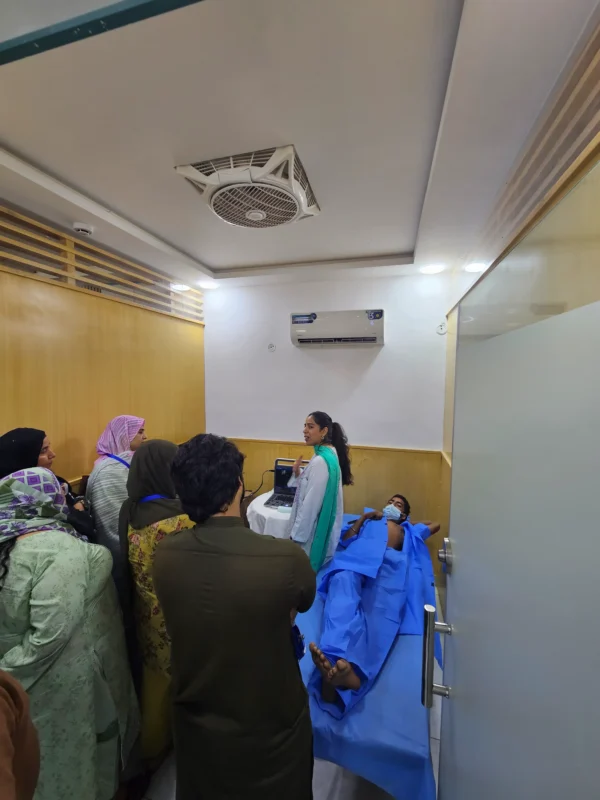
Courses Conducted: 2 Hands-on Workshops

Executive Summary
POCUS.pk is a highly niche medical education website focused specifically on Point-of-Care Ultrasound training and related educational programs for healthcare professionals in Pakistan.
Unlike a general healthcare website that can target thousands of medical topics, POCUS.pk has a much narrower SEO opportunity. Its primary objective is to reach doctors and healthcare professionals who are specifically looking for POCUS courses, hands-on ultrasound workshops, certification, and training opportunities in Pakistan.

Between 5 July and 5 August 2026, Google Search Console recorded:
| SEO Metric | Result |
|---|---|
| Google Search Clicks | 164 |
| Impressions | 2.17K |
| Average CTR | 7.6% |
| Average Position | 7.8 |
| Generative AI Impressions | 562 |
| Successful Paid Leads | 65 |
The most important result was not simply the 164 clicks.
65 of those leads successfully converted into paid registrations/leads, giving a click-to-paid-lead rate of approximately 39.6%.
65 ÷ 164 × 100 = 39.6%
For a highly specialized training website, this demonstrates an important SEO principle:
The quality and intent of traffic can matter more than the total volume of traffic.
1. About POCUS.pk
POCUS.pk is a specialized platform dedicated to Point-of-Care Ultrasound education and training in Pakistan.
The website focuses on hands-on and virtual learning for medical professionals, including emergency physicians, anesthetists, intensivists, pulmonologists, internists, residents, registrars and consultants.
Its training proposition is centered around practical skills rather than purely theoretical learning. The website emphasizes supervised probe handling, image acquisition, scenario-based applications and direct instructor feedback.
This specialization is important when evaluating its SEO performance.
POCUS.pk isn’t trying to rank for every ultrasound-related search.
The strategy is much more focused:
Reach healthcare professionals who are actually interested in POCUS training.
2. The SEO Challenge
The biggest challenge with a niche website is limited search demand.
A website selling general products can potentially target thousands or millions of searches.
A POCUS training website has a much smaller audience.
The target audience is primarily:
- Doctors
- Medical residents
- ICU physicians
- Anesthetists
- Emergency physicians
- Pulmonologists
- Intensivists
- Registrars
- Consultants
- Healthcare professionals interested in bedside ultrasound
The keywords also need to be highly relevant.
For example:
“POCUS training Pakistan”
is far more commercially valuable to this website than a broad search such as:
“ultrasound”
because someone searching for POCUS training is much closer to becoming a course participant.
3. The SEO Objective
The objective wasn’t simply to generate large amounts of traffic.
The goal was:
Generate relevant organic traffic from doctors and healthcare professionals searching for POCUS training and convert that traffic into registrations.
The SEO strategy therefore focused on three stages:
Visibility
Get POCUS.pk discovered for relevant searches.
↓
Qualified traffic
Bring users who are specifically interested in POCUS education and training.
↓
Conversion
Turn that traffic into registrations and paid leads.
This distinction is particularly important for niche businesses.
4. Google Search Console Results
During the 5 July–5 August 2026 reporting period, Google Search Console showed:
164 Clicks
The website received 164 clicks from Google Search.
These clicks represent users who saw a POCUS.pk result in Google and clicked through to the website.
2.17K Impressions
POCUS.pk appeared approximately 2,170 times in Google Search results during the reporting period.
This indicates that Google was regularly presenting the website for relevant searches.
7.6% Average CTR
The website achieved an average Click-Through Rate of 7.6%.
CTR is particularly useful for understanding how effectively search visibility turns into website visits.
A strong CTR can indicate that the combination of the search query, ranking position and search-result presentation is relevant to users.
Average Position: 7.8
The reported average position was 7.8.
That puts the site’s average ranking within the first page of Google results for the searches included in the report.
However, average position should not be interpreted as “the website ranks #7.8 for every keyword.”
Search Console’s average position is calculated across impressions and queries, so individual keywords can rank much higher or lower.
5. The Most Important Number: 65 Paid Leads
This is where the SEO campaign becomes a business case rather than just a traffic report.
From the 164 Google clicks, there were:
65 successful paid leads
That means approximately:
39.6% click-to-paid-lead conversion
This is the strongest outcome in the case study.
The objective wasn’t to generate thousands of visitors who had no interest in the course.
The objective was to reach a relatively small but highly relevant audience.
And that is exactly why niche SEO can be powerful.
6. Why the Conversion Rate Matters
Imagine two websites.
Website A
10,000 visitors
100 qualified leads
Website B
164 visitors
65 paid leads
Website A has much more traffic.
But Website B is producing significantly more business from a much smaller audience.
This is why I don’t evaluate SEO only by:
Traffic → Traffic → More Traffic
For a training business, I prefer:
Relevant Search → Qualified Visit → Registration → Paid Lead
POCUS.pk is a good example of this approach.
7. Content Strategy
One of the key parts of the strategy was creating content around the actual questions and searches of the target audience.
The website now includes educational content addressing topics such as:
- What is Point-of-Care Ultrasound?
- POCUS training in Pakistan
- POCUS courses for doctors
- POCUS workshops in Lahore
- POCUS certification
- How long it takes to learn POCUS
- POCUS training for beginners
- Ultrasound courses in Lahore
- POCUS training in Rawalpindi/Islamabad
- Ultrasound-guided procedures
For example, the site has published content explaining what POCUS is and why clinicians in Pakistan may want to learn it.
It has also published location-specific and intent-focused content, including guides around POCUS training in Lahore and questions beginners commonly ask before registering.
This gives Google more context about:
What the website is about → Who it serves → What training it offers → Where the training is available.
8. Building Topical Relevance
Instead of publishing random articles simply to increase the number of pages, the content strategy focused on staying close to the core subject:
POCUS Training
Supporting topics were then developed around that central subject.
For example:
Core Topic
POCUS Training
↓
Supporting Topics
- POCUS course Pakistan
- POCUS workshop Lahore
- POCUS certification
- POCUS for beginners
- Point-of-care ultrasound
- Ultrasound training for doctors
- Critical care ultrasound
- POCUS in ICU
- POCUS in emergency medicine
- Ultrasound-guided procedures
This creates a more logical content structure and helps the website demonstrate relevance around its core service.
9. Location-Based SEO
Location is particularly important for POCUS.pk because the main product is training.
Someone searching for:
“POCUS course Pakistan”
has different intent from someone searching:
“POCUS workshop Lahore”
or:
“POCUS training Islamabad”
The website has therefore developed location-focused pages and training information for different areas.
POCUS.pk currently has dedicated chapter structures for Lahore, Islamabad–Rawalpindi and Karachi, helping organize its training presence geographically.
This is important because medical professionals are more likely to register for a workshop when the location, date and course information are immediately relevant to them.
10. Commercial Pages + Informational Content
Another important part of the strategy is not relying entirely on blog posts.
There are two different types of search intent:
Informational
“How long does it take to learn POCUS?”
Commercial
“POCUS course Pakistan”
Transactional
“POCUS workshop Lahore registration”
Each type has a different purpose.
Informational content can introduce users to the subject.
Commercial pages can explain the course.
Registration pages can convert the user.
The website therefore needs all three.
For example, POCUS.pk has dedicated training/product pages with course information, dates, fees and registration options.
11. Internal Linking
Internal linking is another important part of the strategy.
A user reading:
“What is POCUS?”
should be able to move naturally toward:
“POCUS Training in Pakistan”
and then toward:
“Register for the upcoming workshop.”
This creates a simple journey:
Learn → Trust → Explore → Register
It also helps search engines understand the relationship between informational content and commercial training pages.
12. Google Generative AI Visibility
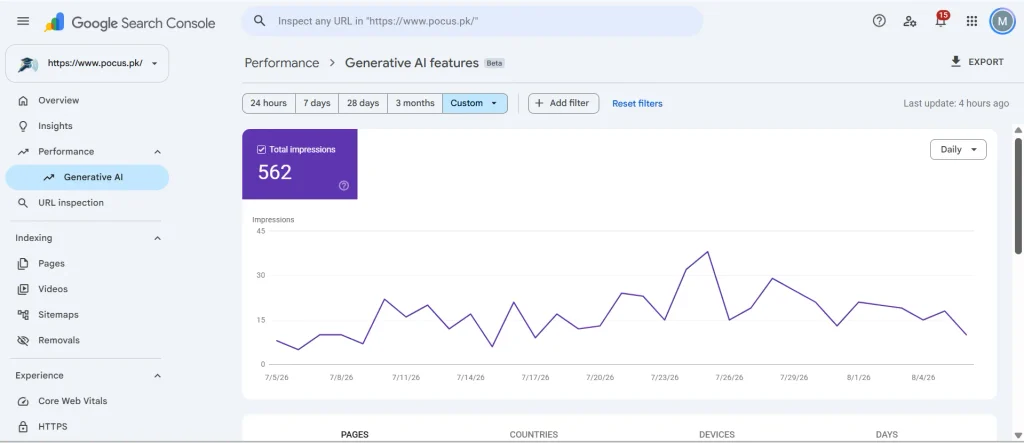
An interesting additional result appears in the second Search Console screenshot.
During the same reporting period, the POCUS.pk Generative AI report shows:
562 impressions
This means POCUS.pk was being surfaced in Google’s reported Generative AI search features during the period.
This is an important early signal for such a niche website.
The website doesn’t have millions of pages or massive search volume.
Yet it was already receiving visibility within Google’s AI-powered search experience.
I would not claim that these 562 impressions generated the 65 paid leads without additional attribution data.
Instead, I would treat this as another indicator that the website is building visibility beyond traditional Google results.
13. Why the AI Visibility Is Important
POCUS is a topic where users often ask questions before they decide to register.
For example:
- What is POCUS?
- Is POCUS useful for doctors?
- Where can I learn POCUS?
- Is POCUS certification worth it?
- What is the best POCUS course in Pakistan?
- How long does it take to learn POCUS?
These are exactly the kinds of questions that can lead users toward educational content.
POCUS.pk has been publishing content addressing several of these questions, including guides on POCUS certification and learning POCUS.
This creates an opportunity to be visible not only when someone is ready to register, but also when they are researching the subject.
14. SEO Strategy Used
The overall approach can be summarized into six areas.
1. Keyword Research
Identify keywords directly related to:
- POCUS
- POCUS training
- POCUS courses
- POCUS certification
- Ultrasound training
- Critical care ultrasound
- POCUS workshops
- Location-specific training
2. Search Intent
Separate keywords into:
Informational → Commercial → Transactional
and create the appropriate page for each.
3. On-Page SEO
Optimize:
- Page titles
- Meta descriptions
- H1/H2 headings
- URLs
- Content structure
- Internal links
- Image information
- Course pages
4. Content Strategy
Publish useful content answering actual questions from the target audience.
5. Local SEO
Create content and landing pages around cities where POCUS training is offered.
6. Conversion Optimization
Make sure users who arrive from Google can quickly:
- Understand the course
- See the date
- See the location
- Understand the benefits
- See the fee
- Register
- Contact the team
15. What Made This Strategy Different?
The biggest difference was focus.
I wasn’t trying to make POCUS.pk rank for every possible medical keyword.
The strategy stayed close to the business.
The website sells POCUS training.
Therefore:
The SEO strategy should revolve around POCUS training.
That sounds simple, but it is an important principle.
A lot of SEO strategies become too broad.
They generate traffic but not customers.
For POCUS.pk, I would rather have:
164 highly relevant clicks
than thousands of irrelevant visits.
The 65 successful paid leads demonstrate why.
16. SEO Funnel
The campaign can be visualized as:
2,170 Google impressions
↓
164 Google clicks
↓
Qualified website visitors
↓
Course/Training pages
↓
Registration enquiries
↓
65 Successful Paid Leads
The overall click-to-paid-lead conversion was approximately:
39.6%
Again, this figure is based on the 65 successful paid leads you provided compared with the 164 Search Console clicks. It should be treated as a directional conversion measure rather than a formally attributed GA4 conversion rate unless the lead source and attribution setup confirm that all 65 originated from those Google clicks.
17. What I Would Do Next
The next phase should focus on scaling what already works rather than changing the strategy completely.
Priority 1 — Expand high-intent keywords
Build more pages around searches such as:
- POCUS course Pakistan
- POCUS training Lahore
- POCUS course Lahore
- POCUS workshop Pakistan
- POCUS certification Pakistan
- Critical care ultrasound course
- Ultrasound training for doctors
Priority 2 — Strengthen location pages
Develop dedicated pages for:
- Lahore
- Karachi
- Islamabad
- Rawalpindi
with genuine information about the respective programs.
Priority 3 — Improve conversion tracking
Track:
Organic visitor → registration → paid registration
rather than only measuring clicks.
Priority 4 — Identify converting pages
Find out which landing pages generated the 65 paid leads.
These pages should receive additional SEO attention.
Priority 5 — Build supporting content
Create articles around questions doctors ask before purchasing a course.
Priority 6 — Monitor AI search
Continue monitoring the Generative AI report and identify which pages are receiving visibility.
18. Key Performance Summary
| KPI | Result |
|---|---|
| Reporting Period | 5 July – 5 August 2026 |
| Google Search Impressions | 2.17K |
| Google Search Clicks | 164 |
| Average CTR | 7.6% |
| Average Position | 7.8 |
| Generative AI Impressions | 562 |
| Successful Paid Leads | 65 |
| Click → Paid Lead Rate | 39.6% |
Conclusion
The POCUS.pk SEO campaign is a good example of why niche SEO should not be judged purely by traffic volume.
POCUS.pk operates in a very specialized market. Its potential audience is limited compared with a general e-commerce or news website.
The goal was therefore not to attract everyone.
The goal was to attract the right people:
Doctors and healthcare professionals looking for POCUS education and training.
During the 30-day period from 5 July to 5 August 2026, the website generated:
2.17K Google impressions
164 Google clicks
7.6% average CTR
7.8 average position
562 Generative AI impressions
and, most importantly, 65 successful paid leads.
The resulting 39.6% click-to-paid-lead ratio makes the business outcome more meaningful than the traffic numbers alone.
The main lesson from this project is simple:
For a highly niche business, the objective of SEO isn’t to get the most traffic. It’s to get the most relevant traffic and turn that traffic into business.
And in the case of POCUS.pk, the early results show that a focused SEO strategy can do exactly that.