
How JumaBazar.pk Gained 10.6K Google AI Search Impressions
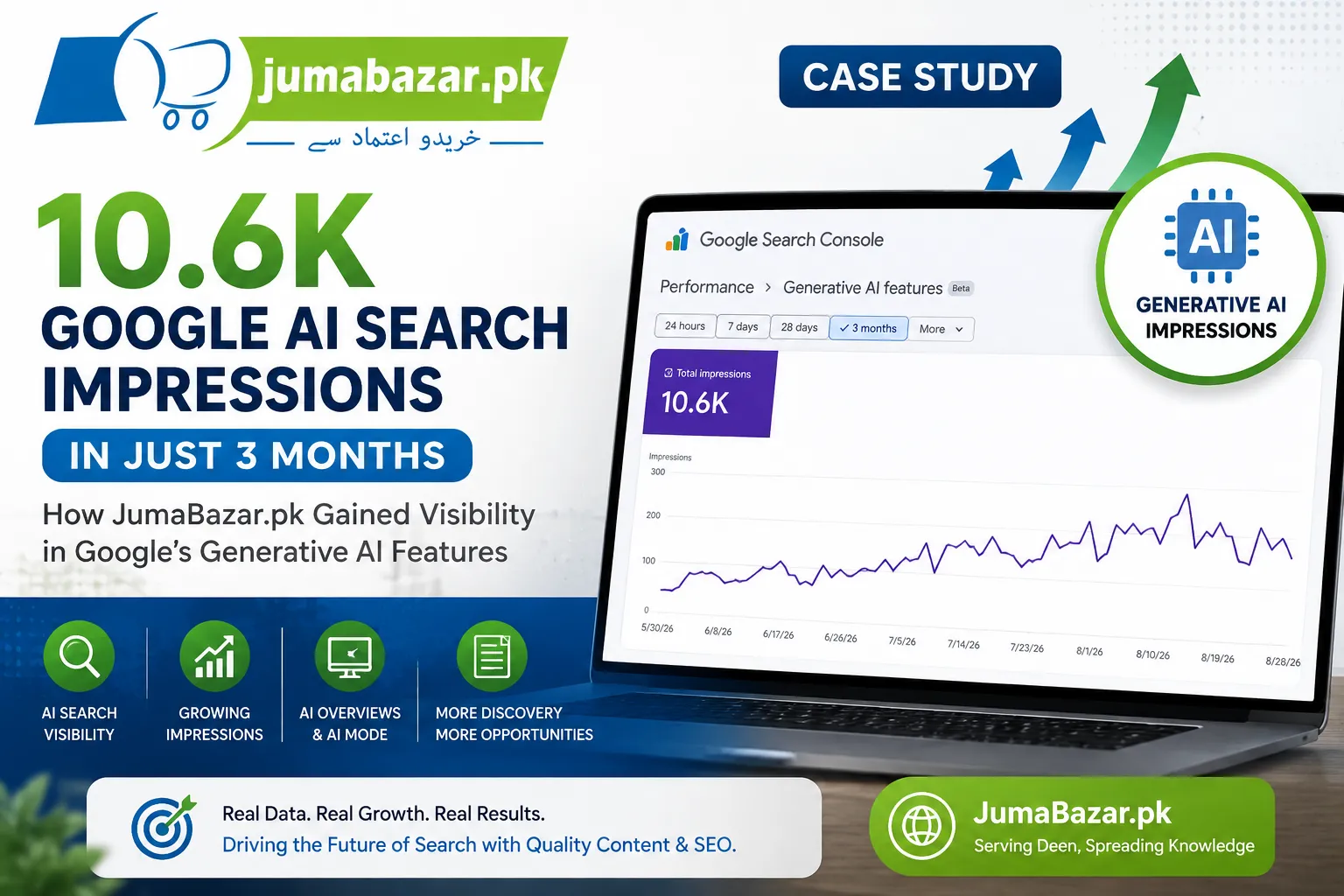
Case Study: How JumaBazar.pk Started Gaining Visibility in Google’s AI Search
By Muhammad Shahroze Rashid | SEO & Digital Marketing Professional
Search is changing quickly.
People are no longer using Google only to find a list of blue links. Google is increasingly showing AI-generated answers through features such as AI Overviews and AI Mode, where websites can be used as supporting sources.
For SEO professionals, this creates a new question:
Is my website appearing in Google’s AI-generated search results?
Recently, I checked the Generative AI performance report in Google Search Console for JumaBazar.pk and found a promising result.
Over a three-month period, the website received 10.6K impressions from Google’s Generative AI features.
This case study explains what I found, what the data means, and why I believe this is an important development for the website’s SEO strategy.
The Result at a Glance
According to the Google Search Console screenshot from the JumaBazar.pk property:
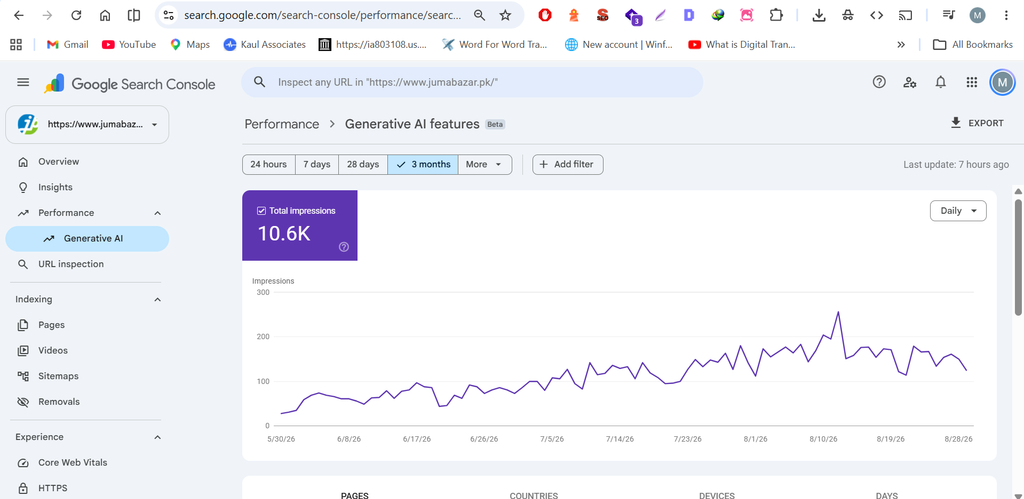
| Metric | Result |
|---|---|
| Reporting period | 3 months |
| Period shown | May 30 – August 28, 2026 |
| Generative AI impressions | 10.6K |
| Google Search Console report | Generative AI features |
| Website | JumaBazar.pk |
The screenshot shows a clear upward movement in daily impressions during much of the reporting period.
The website started around a few dozen daily impressions at the beginning of the period and later reached several hundred impressions on stronger days.
The total reported figure reached 10.6K impressions.
What Are Generative AI Impressions?
This is an important distinction.
An impression does not mean that someone visited the website.
Google explains that an impression in the Generative AI performance report means a link to your website was shown to a user in a generative AI feature on Google Search. The current report includes AI Overviews and AI Mode.
So, in this case:
10.6K impressions ≠ 10.6K website visitors
It means JumaBazar.pk’s links were shown 10.6K times in the reported Google Search generative AI features during the selected period.
That distinction is important when presenting an SEO case study honestly.
What I Found in Google Search Console
The screenshot shows the Generative AI section inside Google Search Console.
The selected period is:
3 months
The graph begins around:
May 30, 2026
and runs through:
August 28, 2026
The total displayed is:
10.6K Total Impressions
More interestingly, the graph shows that visibility increased over time.
At the beginning of the period, daily impressions were relatively low.
As the weeks progressed, the website began receiving considerably more daily impressions, with several days reaching well above 150 and one visible peak moving above 250 impressions.
This is more useful to me than simply looking at the final 10.6K number.
It shows that the website was gaining visibility in Google’s AI search features over the period shown.
Why This Matters for SEO
AI search visibility is becoming another part of the search journey.
Google’s Generative AI performance report was created specifically to help website owners understand how their sites perform in these AI-powered search features. Google says the report can show changes in AI impressions over time, the pages receiving those impressions, and where the impressions come from by country or device.
For a website like JumaBazar.pk, this creates an additional opportunity.
Someone might search Google for a question related to:
- Quran
- Quran translation
- Islamic books
- Islamic products
- Quran for children
- Quran learning
- Islamic gifts
- Quran editions
Instead of receiving only traditional search results, the user may now receive an AI-generated response with links to supporting websites.
The goal is therefore not simply:
“Rank #1 for a keyword.”
The wider goal is:
Create useful, trustworthy pages that Google can understand and potentially use as sources when answering relevant searches.
What SEO Work Supports This?
The 10.6K figure should not be presented as proof that one specific SEO activity caused the increase.
SEO doesn’t work that way.
The website’s AI visibility is the result of the overall search presence of the site, and several areas can contribute to that visibility.
During my work with JumaBazar.pk, the broader SEO approach included areas such as:
Keyword research
Understanding what people search for and which topics are relevant to the products and services offered.
Search intent
Creating pages that match what users are actually looking for rather than simply targeting keywords.
On-page SEO
Improving titles, headings, content, URLs, product information and other page elements.
Content development
Creating useful information around Quran, Islamic products and related topics.
Internal linking
Connecting relevant articles, categories and product pages so users and search engines can understand the relationship between them.
Product and category optimization
Making commercial pages more useful and more clearly focused on their topics.
Technical SEO
Working on website structure, indexability, performance and other technical areas that affect search visibility.
Google Search Console
Using actual search data to understand how Google is discovering and displaying the website.
One Thing I Would Not Claim
There is an important lesson here for SEO reporting.
I would not say:
“SEO generated 10.6K visitors from AI search.”
The screenshot doesn’t show that.
It shows:
10.6K Generative AI impressions.
That’s a much more accurate statement.
I also wouldn’t claim that the entire increase was caused by a single optimization.
The correct conclusion is that JumaBazar.pk achieved measurable visibility in Google’s Generative AI search features, with 10.6K reported impressions during the three-month period shown.
That is what the data supports.
The Growth Pattern Is More Interesting Than the Number
When I look at the graph, the first thing I notice isn’t just the 10.6K total.
It’s the direction of the graph.
The website moved from relatively low daily visibility at the start of the period toward significantly higher daily impression levels later in the period.
There are naturally some fluctuations.
SEO traffic and search visibility are rarely perfectly linear.
Some days are higher.
Some days are lower.
But the overall graph shows a stronger level of AI-search visibility toward the later part of the reporting period.
That’s the kind of trend I want to monitor.
How I Would Continue the Strategy
The next step isn’t to celebrate 10.6K and stop.
It is to find out which pages and topics are generating those impressions.
Google’s Generative AI report allows website owners to break the data down by pages, countries, devices and dates.
I would use that information to identify:
1. Which pages are appearing?
Some pages may be significantly more visible than others.
2. Which topics are working?
If certain Quran or Islamic-book topics are appearing more frequently, they can guide future content.
3. Which pages have potential for more traffic?
Pages getting AI impressions but little traditional organic traffic could be worth reviewing.
4. What content deserves expansion?
If Google is already finding a page useful for a topic, adding genuinely useful supporting information may strengthen the page.
5. Are users actually clicking?
This is where traditional Search Console performance data becomes important.
Google Search Console separately reports clicks, impressions, CTR and average position for Search performance.
AI Search Doesn’t Replace Traditional SEO
This is another important point.
I don’t see AI search optimization as a completely separate activity from SEO.
The fundamentals still matter.
A website needs:
- Useful content
- Clear information
- Good website structure
- Crawlable pages
- Relevant internal links
- Strong topical relevance
- Good user experience
- Clear authorship where appropriate
- Accurate information
- A trustworthy website
Google’s current Generative AI controls also confirm that websites can be included in AI Overviews and AI Mode, where their content can be used to help ground AI responses and their links can receive impressions and traffic.
So I don’t think the answer is to create a completely different website just for AI.
The better approach is to build a good website that works for people and is easy for search engines to understand.
What This Case Study Taught Me
This report gave me another useful lesson from working on JumaBazar.pk:
SEO visibility is expanding.
We used to focus heavily on:
Rankings → Clicks → Traffic
Now we also need to pay attention to:
Search visibility → AI visibility → Citations/links → Clicks → Conversions
The numbers in Search Console don’t tell the entire story, but they give us another way to understand how a website is being discovered.
JumaBazar.pk: From Traditional SEO to AI Search Visibility
I’ve previously documented another JumaBazar SEO milestone where the website reached 11K Google Search clicks in a reported 28-day period.
Now, the Generative AI report provides another interesting piece of the SEO picture:
10.6K Generative AI impressions in 3 months
These are two different metrics and should not be combined as if they represent the same thing.
But together, they show why modern SEO requires looking beyond one ranking position or one traffic number.
My Approach to AI Search SEO
I don’t believe there is a magic formula for appearing in AI search.
Instead, my approach is straightforward:
Understand what people are asking
↓
Create a page that answers the question properly
↓
Make the information easy to understand
↓
Build topical relevance
↓
Connect related content
↓
Keep the technical foundation clean
↓
Monitor Search Console
↓
Find what is working
↓
Improve it
That’s the same basic SEO approach I’ve used for traditional search.
The difference is that we now have more ways to measure how Google is using and displaying website content.
Final Takeaway
The 10.6K Generative AI impressions recorded for JumaBazar.pk are an encouraging sign that the website is gaining visibility in Google’s newer AI-powered search features.
But I would treat this as a new SEO opportunity, not the final result.
The next questions are more important:
- Which pages are appearing?
- Which topics are generating impressions?
- Which countries and devices are contributing?
- How many users click through?
- Which pages lead to conversions?
- How can we improve the pages already receiving visibility?
That’s where the real SEO work begins.
For me, this is the most interesting part of SEO in 2026: we now have more data to understand not only whether a website is appearing in Google, but also how it is being surfaced inside Google’s AI search experiences.